
Modern women often have busy schedules filled with work, family responsibilities, social commitments, travel, and personal goals. With so much to manage, hair care can easily move down the priority list.
But maintaining healthy-looking, beautiful hair does not always require hours every day. With the right routine and a few simple habits, you can keep your hair manageable, smooth, and fresh even when you have a busy lifestyle.
From choosing the right shampoo to protecting your hair from heat and maintaining regular salon care, small changes can make a big difference.
In this blog, we share the top 15 hair maintenance tips for busy women that are easy to follow and suitable for everyday life.
Why Is Hair Maintenance Important for Busy Women?
Busy lifestyles can expose your hair to several stress factors, including pollution, dust, sun exposure, humidity, hard water, frequent washing, heat styling, and chemical treatments.-Hair Maintenance
When hair does not receive proper care, common concerns may include:
- Dryness
- Frizz
- Hair breakage
- Split ends
- Rough texture
- Dull appearance
- Difficult-to-manage hair
A simple and consistent hair maintenance routine can help you manage these concerns and maintain healthier-looking hair.
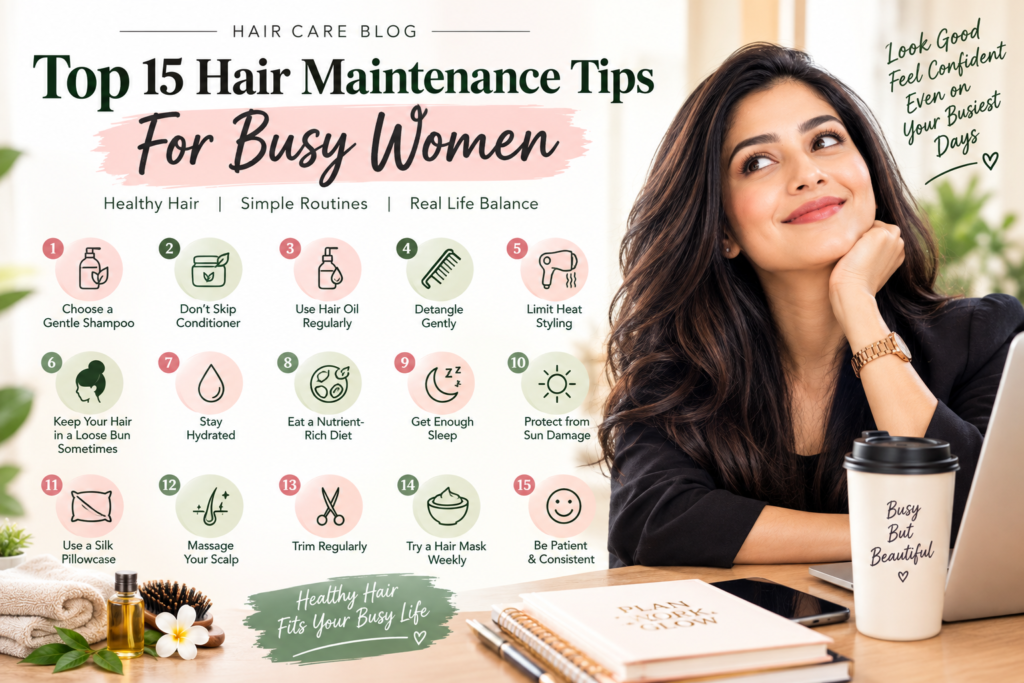
Top 15 Hair Maintenance Tips for Busy Women
1. Choose a Shampoo According to Your Hair Type
One of the easiest ways to improve your hair-care routine is to choose the right shampoo.
Different hair types have different needs. Oily scalps may need a different cleansing routine than dry or curly hair.
Consider your:
- Scalp condition
- Hair texture
- Hair dryness
- Chemical treatments
- Washing frequency
If your hair is coloured, straightened, smoothened, or chemically treated, ask your hairstylist about suitable professional or treatment-friendly products.
The goal is not to find the most expensive shampoo but to find one that suits your hair and scalp.
2. Don’t Skip Conditioner
When you’re in a hurry, it is tempting to shampoo and leave the shower immediately. However, conditioner can be an important part of maintaining manageable hair.
Apply conditioner mainly to the mid-lengths and ends rather than heavily applying it to the scalp.
Regular conditioning can help improve:
- Softness
- Smoothness
- Manageability
- Detangling
- Hair texture
For busy women, a good conditioner can make everyday styling much easier.
3. Create a Simple Weekly Hair-Care Routine
You don’t need a complicated 10-step routine.
Instead, create a simple weekly schedule that you can realistically follow.
For example:
Daily: Gentle brushing and basic protection
Wash days: Shampoo + conditioner
Weekly: Hair mask or suitable deep-conditioning treatment
Monthly or as needed: Professional salon treatment
A routine that you can maintain consistently is usually more practical than an elaborate routine that you stop after a few days. -Hair Maintenance
4. Limit Excessive Heat Styling
Straighteners, curling irons, and blow dryers can help you create quick hairstyles, but frequent high-heat styling can contribute to dryness and damage.
If you use heat styling:
- Use a heat protectant
- Avoid unnecessarily high temperatures
- Don’t repeatedly pass the same section of hair
- Give your hair heat-free days whenever possible
For busy mornings, simple hairstyles that require minimal heat can help reduce unnecessary stress on your hair.
5. Protect Your Hair From Sun and Pollution
Daily commuting and outdoor activities expose hair to sunlight, dust, and pollution.
Over time, environmental exposure can contribute to a dull or dry appearance.
When spending extended periods outdoors, consider:
- Covering your hair with a scarf or hat
- Using suitable hair-care products
- Washing your hair according to your scalp’s needs
- Avoiding unnecessary exposure to harsh environmental conditions
These simple precautions can become part of your everyday hair maintenance routine. –Hair Maintenance
6. Don’t Brush Wet Hair Aggressively
Wet hair is more vulnerable to mechanical damage.
Instead of immediately pulling through knots with a brush, gently remove excess water and use a wide-tooth comb if appropriate for your hair type.
Start from the ends and gradually work upward toward the roots.
Avoid forceful brushing because it can contribute to unnecessary breakage.
This small habit takes only a few extra minutes but can make your hair-care routine gentler. –Hair Maintenance
7. Keep Your Scalp Clean
Healthy-looking hair starts with a clean and comfortable scalp.
Sweat, oil, styling products, dust, and environmental pollutants can accumulate on the scalp.
Wash your hair according to your scalp and hair needs rather than following a fixed rule that applies to everyone.
If you experience persistent itching, severe dandruff, redness, or scalp irritation, consider consulting a dermatologist.
8. Use a Hair Mask Regularly
A hair mask can provide additional conditioning when your hair feels dry, rough, or difficult to manage.
Busy women can keep this simple by using a suitable mask once a week or according to professional advice.
Apply the product according to its instructions, concentrating on areas that need conditioning, particularly the lengths and ends.
If your hair is chemically treated or highly damaged, a professional can help you choose an appropriate treatment. –Hair Maintenance
9. Keep Your Hair Hydrated and Conditioned
Dry-looking hair can become difficult to style and manage.
Regular conditioning, suitable leave-in products, and occasional deep-conditioning treatments can help improve the feel and appearance of dry hair.
However, avoid using too many products at once.
A simple routine with the right products is often easier to maintain than a large collection of products that you rarely use. –Hair Maintenance
10. Trim Your Hair Regularly
Split and damaged ends can make hair look rough and unkempt.
Regular trims can help maintain a neat shape and remove visibly damaged ends.
How often you need a haircut depends on your hairstyle, hair growth, damage level, and personal preference.
If you are growing your hair, you can discuss the appropriate trimming schedule with your hairstylist.
Remember that trimming does not make hair grow faster from the scalp; it helps maintain the appearance and condition of the lengths.
11. Choose Low-Maintenance Hairstyles
Busy mornings are much easier when your hairstyle does not require excessive time.
Consider simple styles such as:
- Low ponytails
- Loose braids
- Claw-clip styles
- Low buns
- Natural waves
Avoid excessively tight hairstyles every day, as repeated tension can place stress on the hair and scalp.
A few reliable hairstyles can save time while keeping you looking polished.
12. Be Careful With Chemical Treatments
Hair colouring, bleaching, smoothening, straightening, and other chemical services can change the condition of your hair.
If you frequently use chemical treatments, give your hair appropriate maintenance between salon appointments.
Always inform your stylist about your previous chemical services before starting another treatment.
Professional assessment is particularly important if your hair is already dry, brittle, or breaking.
13. Choose Hair Products Carefully
Busy women often purchase products because they are trending or heavily advertised.
Instead, choose products according to your actual hair and scalp requirements.
Look for products suitable for:
- Your hair texture
- Scalp condition
- Chemical treatment history
- Level of dryness
- Styling routine
If you are confused by the number of available products, ask your hairstylist for a simple routine containing only the essentials.
14. Schedule Professional Hair Treatments
Home care is important, but professional salon treatments can provide additional conditioning and maintenance.
Depending on your hair condition, options may include:
- Hair Spa
- Protein Treatment
- Deep Conditioning
- Scalp Care
- Hair Repair Treatments
For example, a hair spa for dry and damaged hair can provide professional cleansing, conditioning, massage, and treatment depending on the service.
Similarly, protein-based treatments may be recommended for certain types of chemically stressed hair.
The right treatment should always be selected according to your individual hair condition.
15. Follow a Consistent Hair-Care Routine
The most important hair maintenance tip is consistency.
You don’t need to spend hours every day caring for your hair.
Instead:
- Use suitable products
- Condition regularly
- Reduce excessive heat
- Protect your hair outdoors
- Handle wet hair gently
- Trim damaged ends
- Maintain appropriate salon appointments
Small habits performed consistently can be more practical than occasional intensive care.
Quick 10-Minute Hair Maintenance Routine for Busy Women
If you have very little time, try this simple routine:
Morning
2 minutes: Gently detangle your hair.
2 minutes: Apply a suitable leave-in or anti-frizz product if needed.
3 minutes: Choose a simple low-maintenance hairstyle.
3 minutes: Protect your hair from excessive sun or environmental exposure when heading outdoors.
Wash Day
Use a suitable shampoo, follow with conditioner, gently towel-dry your hair, and avoid aggressive brushing.
This simple approach can help you maintain your hair without turning hair care into a time-consuming task.
Hair Maintenance Tips for Chemically Treated Hair
If you regularly colour, bleach, straighten, smoothen, or otherwise chemically treat your hair, your maintenance routine may need additional attention.
Consider these tips:
- Follow your stylist’s aftercare instructions.
- Avoid unnecessary heat styling.
- Condition your hair regularly.
- Use products compatible with your treatment.
- Schedule professional maintenance when required.
- Avoid performing multiple aggressive chemical services too close together without professional advice.
Chemically treated hair often benefits from a more personalised maintenance plan.
Common Hair-Care Mistakes Busy Women Should Avoid
Even a good routine can be affected by common mistakes.
Washing With Extremely Hot Water
Very hot water may leave some hair feeling dry. Use comfortably warm or lukewarm water instead.
Sleeping With Very Wet Hair
Allow your hair to dry appropriately before sleeping to reduce unnecessary friction and tangling.
Tight Hairstyles Every Day
Repeated tension from very tight ponytails or buns can stress the hair and scalp.
Too Many Styling Products
Using several products at once can cause buildup and make hair difficult to manage.
Ignoring Persistent Hair Problems
Excessive hair loss, sudden breakage, persistent scalp irritation, or severe dandruff may require professional medical evaluation rather than only cosmetic treatments.
Final Thoughts
Being busy does not mean you have to compromise on hair care.
The key to effective hair maintenance for busy women is creating a simple routine that fits naturally into your lifestyle. Choosing the right shampoo, conditioning regularly, limiting heat styling, protecting your hair from environmental exposure, trimming damaged ends, and maintaining appropriate professional treatments can all contribute to healthier-looking, manageable hair.
You don’t need to spend hours every day on your hair. A few consistent habits can make your daily routine easier and help your hair look smoother, fresher, and more polished.
Remember, every person’s hair is different. What works for one person may not work for another. If your hair is severely damaged, chemically treated, or experiencing persistent problems, consider getting a professional assessment.
Healthy-looking hair doesn’t require a complicated routine—it requires the right routine and consistency.
Frequently Asked Questions About Hair Maintenance
1. How can busy women maintain healthy-looking hair?
Keep your routine simple. Use suitable shampoo and conditioner, limit heat styling, protect your hair from environmental exposure, trim damaged ends, and use professional treatments when appropriate.
2. How often should I wash my hair?
There is no single schedule for everyone. Washing frequency should depend on your scalp condition, hair type, lifestyle, sweat, oil production, and product use.
3. Is conditioner necessary for hair?
Conditioner can help improve softness, smoothness, detangling, and manageability. It is particularly useful when hair tends to feel dry or rough.
4. How can I reduce hair damage from straightening?
Use a heat protectant, avoid excessive temperatures, reduce the frequency of heat styling, and avoid repeatedly applying heat to the same section.
5. Is hair spa good for busy women?
A professional hair spa can be a convenient way to provide additional conditioning and grooming as part of a regular hair-care routine. The appropriate treatment depends on your hair condition.
6. How often should I get a haircut?
It depends on your hairstyle, hair condition, growth, and personal preference. Regular trims can help maintain the appearance of damaged or split ends.
7. What is the best hairstyle for busy mornings?
Low-maintenance styles such as loose braids, low ponytails, claw-clip styles, and simple buns can save time and reduce the need for extensive heat styling.
8. Can pollution damage hair?
Regular exposure to pollution, dust, and environmental conditions can contribute to a dull or unclean feeling and may affect hair appearance. Appropriate cleansing and protection can help maintain hair quality.
9. How can I maintain chemically treated hair?
Use treatment-compatible products, condition regularly, limit excessive heat, follow professional aftercare instructions, and schedule appropriate salon maintenance.
10. What is the most important hair maintenance tip?
Consistency is key. A simple routine that you follow regularly is more practical than a complicated routine that you cannot maintain.If you are interested in Hair Maintenance Treatments and Tips, then contact us.